
Models
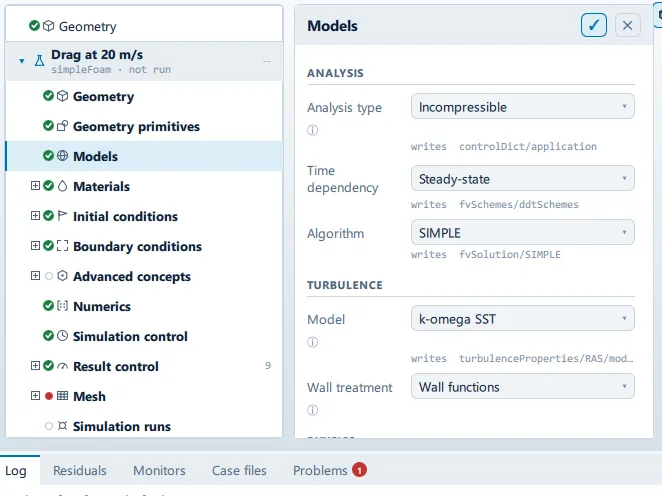
Where it is
Section titled “Where it is”Setup tree: Models
Controls
Section titled “Controls”Analysis
Section titled “Analysis”Analysis type
Section titled “Analysis type”- Control: choice (
ComboRow) - Default:
Incompressible - Bound to:
CaseState.analysisType - Options:
Incompressible,Compressible,Convective Heat Transfer,Conjugate Heat Transfer,Multiphase (VoF),Multiphase (Euler-Euler),Particles (Lagrangian),Combustion / Reacting,Atmospheric & Wind,Marine & Waves,Scalar transport,Cavitation,Supersonic / shock,Solid conduction,Compressible multiphase,Miscible mixing,Sediment / drift flux,Shallow water,Free surface (potential),Premixed combustion,Spray,Solid stress,Electrostatics,Magnetostatics,Magnetohydrodynamics,Rotating frame (SRF),Molecular / rarefied - Writes:
controlDict/application
The in-app guidance depends on the case:
- Mach < 0.3, density variation negligible.
- Particles rather than fields. No velocity, no pressure, no turbulence model - the Molecular step replaces Materials, Initial conditions, Boundary conditions and Numerics.
- See the Create Simulation dialog for the full description.
Time dependency
Section titled “Time dependency”- Control: choice (
ComboRow) - Default:
Steady-state - Bound to:
CaseState.timeDependency - Options:
Transient,Steady-state(fromeither branch ofCaseState.transientOnly``) - Writes:
fvSchemes/ddtSchemes
This analysis has no steady form - the solver integrates in time.
Algorithm
Section titled “Algorithm”- Control: choice (
ComboRow) - Default:
SIMPLE - Bound to:
CaseState.algorithm - Options:
SIMPLE,SIMPLEC,PIMPLE,PISO(fromeither branch ofCaseState.steady``) - Writes:
fvSolution/…
Turbulence
Section titled “Turbulence”- Control: choice (
ComboRow) - Default:
k-omega SST - Bound to:
CaseState.turbulenceModel - Options:
Laminar,k-epsilon,realizable k-epsilon,RNG k-epsilon,k-omega,k-omega SST,k-omega SST LM,GEKO,EBRSM,Spalart-Allmaras,LRR (RSM),SSG (RSM),LES WALE,LES Smagorinsky,SA-DDES,SST-IDDES - Writes:
turbulenceProperties/RAS/model
Wall treatment
Section titled “Wall treatment”- Control: choice (
ComboRow) - Default:
Wall functions - Bound to:
CaseState.wallTreatment - Options:
Wall functions,Resolved (low-Re),Automatic blending
Selects a coherent set across nut, k, omega and alphat.
Physics
Section titled “Physics”Energy equation
Section titled “Energy equation”- Control: on/off (
ToggleRow) - Default:
false - Bound to:
CaseState.energyEnabled
Gravity / buoyancy
Section titled “Gravity / buoyancy”- Control: on/off (
ToggleRow) - Default:
false - Bound to:
CaseState.gravityEnabled
Surface tension
Section titled “Surface tension”- Control: value (
ValueField) - Unit: N/m
- Default:
0.07 - Bound to:
CaseState.surfaceTension - Writes:
transportProperties/sigma - Shown when:
CaseState.analysisFamily === "fluids" && String(CaseState.solver).indexOf("inter") >= 0
Between the two phases. 0.07 N/m is water against air at 20 C.
Problems reported against this step
Section titled “Problems reported against this step”The application checks these before a run and reports them in the Problems tab against this step.
| Severity | Message |
|---|---|
| error | … |
| error | … |
| error | … has no steady form. … integrates in time; set Time dependency to Transient. |
| info | The ignition kernel (… mm) is narrower than two mesh cells, so it is written … mm wide: the flame-wrinkling transport equation diverges on a spark that fits inside one cell. Refine the mesh if the kernel size matters. |
| error | A two-phase case needs gravity. Without it there is nothing to separate the phases and the interface will not settle. |
| error | … has no turbulence model, so it will not read k, omega or nut. Set the turbulence model to Laminar, or choose a solver that has one. |
| error | … has no steady form. Set the time dependency to Transient. |
| error | … has no transient form. Set the time dependency to Steady-state. |
| warn | … needs …, which this app does not write. Add it to the case directory before running. |
| warn | … cannot be set up completely by this build: it needs …. The case will be written and the mesh will build, but the solver stops at start-up. |
| warn | This build of the equilibrium stress solver does not converge - the correction it computes points away from equilibrium, and the run ends on a floating-point trap whatever the acceleration factor. Displacement solves the same steady problem on this case, because the time scheme here is already steady, and it converges. |
| error | … is not part of the … tier. The case is safe and nothing has been lost - choosing another analysis type, or upgrading, will let it run. |
| warn | Gravity is off for a buoyancy-sensitive analysis type. |
… marks a value the application computes at run time, so the source carries no fixed text for it.