
Numerics
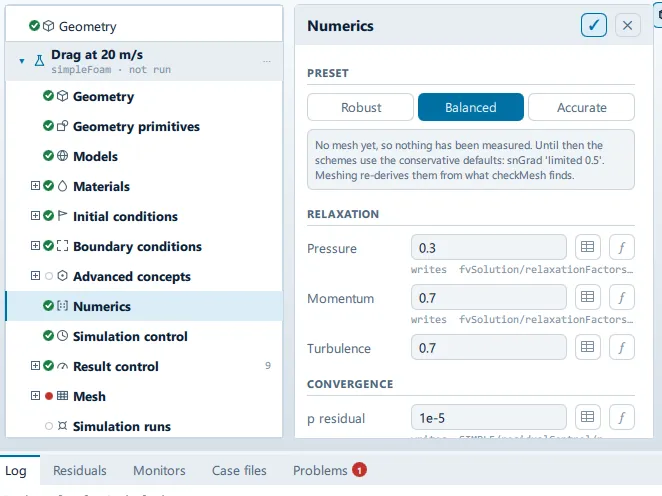
Where it is
Section titled “Where it is”Setup tree: Numerics
Controls
Section titled “Controls”Relaxation
Section titled “Relaxation”Pressure
Section titled “Pressure”- Control: value (
ValueField) - Bound to:
CaseState.effectiveRelaxP - Writes:
fvSolution/relaxationFactors/fields/p
Transonic transient writes no field relaxation at all - PIMPLE solves p unrelaxed, whatever this reads.
Momentum
Section titled “Momentum”- Control: value (
ValueField) - Bound to:
CaseState.effectiveRelaxU - Writes:
fvSolution/relaxationFactors/equations/U
Transonic transient relaxes every equation at the one wildcard factor below, whatever this reads.
Turbulence
Section titled “Turbulence”- Control: value (
ValueField) - Bound to:
CaseState.effectiveRelaxTurb
Transonic transient’s single wildcard factor covers this too.
Adjoint
Section titled “Adjoint”- Control: value (
ValueField) - Default:
0.1 - Bound to:
CaseState.relaxAdjoint - Writes:
fvSolution/relaxationFactors/alpha - Value modes: none (plain entry)
- Shown when:
CaseState.solver === "adjointShapeOptimizationFoam"
How fast the optimisation is allowed to move material between solid and fluid.
Scalar
Section titled “Scalar”- Control: value (
ValueField) - Default:
0.9 - Bound to:
CaseState.relaxScalar - Writes:
fvSolution/relaxationFactors/… - Value modes: none (plain entry)
- Shown when:
CaseState.physicsFamily === "scalar"
Pressure floor
Section titled “Pressure floor”- Control: value (
ValueField) - Unit: Pa
- Default:
10000 - Bound to:
CaseState.minPressure - Writes:
pMin - Value modes: none (plain entry)
- Shown when:
CaseState.compressible
pMin. The floor a compressible solve clamps pressure to, so a transient undershoot cannot take it negative and end the run. Raise it for a high-pressure case; lower it for a vacuum one.
Convergence
Section titled “Convergence”p residual
Section titled “p residual”- Control: value (
ValueField) - Default:
1e-5 - Bound to:
CaseState.resP - Writes:
SIMPLE/residualControl/p - Shown when:
CaseState.steady
U residual
Section titled “U residual”- Control: value (
ValueField) - Default:
1e-6 - Bound to:
CaseState.resU - Writes:
SIMPLE/residualControl/U - Shown when:
CaseState.steady
Show advanced schemes
Section titled “Show advanced schemes”- Control: on/off (
ToggleRow) - Default:
false
Schemes
Section titled “Schemes”div(phi,U)
Section titled “div(phi,U)”- Control: choice (
ComboRow) - Default:
linearUpwind grad(U) - Bound to:
CaseState.divScheme - Options:
linearUpwind grad(U),linear,upwind,LUST grad(U),limitedLinear 1,vanLeer,QUICK - Writes:
fvSchemes/divSchemes/div(phi,U) - Shown when:
root.advanced
grad(U)
Section titled “grad(U)”- Control: choice (
ComboRow) - Default:
cellLimited Gauss linear 1 - Bound to:
CaseState.gradScheme - Options:
Gauss linear,cellLimited Gauss linear 1,leastSquares - Writes:
fvSchemes/gradSchemes/grad(U) - Shown when:
root.advanced
snGrad
Section titled “snGrad”- Control: choice (
ComboRow) - Default:
limited 0.5 - Bound to:
CaseState.snGradScheme - Options:
corrected,limited 0.5,limited 0.33,uncorrected,orthogonal - Writes:
fvSchemes/snGradSchemes/default - Shown when:
root.advanced
p solver
Section titled “p solver”- Control: choice (
ComboRow) - Default:
GAMG - Bound to:
CaseState.pSolver - Options:
GAMG,PCG,PPCG,PBiCGStab - Writes:
fvSolution/solvers/p/solver - Shown when:
root.advanced
Momentum solver
Section titled “Momentum solver”Tolerance
Section titled “Tolerance”- Control: value (
ValueField) - Default:
1e-07 - Bound to:
CaseState.uSolverTolerance - Writes:
fvSolution/solvers/U/… - Value modes: none (plain entry)
- Shown when:
root.advanced
Relative tolerance
Section titled “Relative tolerance”- Control: value (
ValueField) - Default:
0.1 - Bound to:
CaseState.uSolverRelTol - Writes:
fvSolution/solvers/U/… - Value modes: none (plain entry)
- Shown when:
root.advanced
Max iterations
Section titled “Max iterations”- Control: value (
ValueField) - Default:
1000 - Bound to:
CaseState.uSolverMaxIter - Writes:
fvSolution/solvers/U/… - Value modes: none (plain entry)
- Shown when:
root.advanced
Pressure solver
Section titled “Pressure solver”Tolerance
Section titled “Tolerance”- Control: value (
ValueField) - Default:
1e-06 - Bound to:
CaseState.pSolverTolerance - Writes:
fvSolution/solvers/p_rgh/tolerance - Value modes: none (plain entry)
- Shown when:
root.advanced
Absolute residual the pressure solve has to reach. Tightening it costs iterations; loosening it lets error accumulate between correctors.
Relative tolerance
Section titled “Relative tolerance”- Control: value (
ValueField) - Default:
0.01 - Bound to:
CaseState.pSolverRelTol - Writes:
fvSolution/solvers/p_rgh/relTol - Value modes: none (plain entry)
- Shown when:
root.advanced
How far the residual has to fall within one solve, as a fraction of where it started. The final corrector always uses 0 - it has to converge properly.
Max iterations
Section titled “Max iterations”- Control: value (
ValueField) - Default:
1000 - Bound to:
CaseState.pSolverMaxIter - Writes:
fvSolution/solvers/p_rgh/maxIter - Value modes: none (plain entry)
- Shown when:
root.advanced
The ceiling a failing pressure solve runs into. It was never written, so OpenFOAM’s own 1000 applied and the run hit it without anything saying so.
Cells in coarsest level
Section titled “Cells in coarsest level”- Control: value (
ValueField) - Default:
10 - Bound to:
CaseState.pSolverCoarsestCells - Writes:
fvSolution/solvers/p_rgh/nCellsInCoarsestLevel - Value modes: none (plain entry)
- Shown when:
root.advanced && CaseState.pSolver === "GAMG"
How far GAMG coarsens before it solves directly. Smaller means more levels and a cheaper coarse solve; 10 is what SimScale uses, and this app hard-coded 100.
Lists this panel shows
Section titled “Lists this panel shows”Read straight from the data behind the panel, not from a hand-written list.
Preset
Section titled “Preset”From a fixed list in the application.
- Robust
- Balanced
- Accurate
Problems reported against this step
Section titled “Problems reported against this step”The application checks these before a run and reports them in the Problems tab against this step.
| Severity | Message |
|---|---|
| error | The solution diverged: the residuals grew instead of falling. Lower the relaxation factors, improve the worst cells on the Quality pane, or start from potential flow. |
… marks a value the application computes at run time, so the source carries no fixed text for it.